

BeatTheHeat II
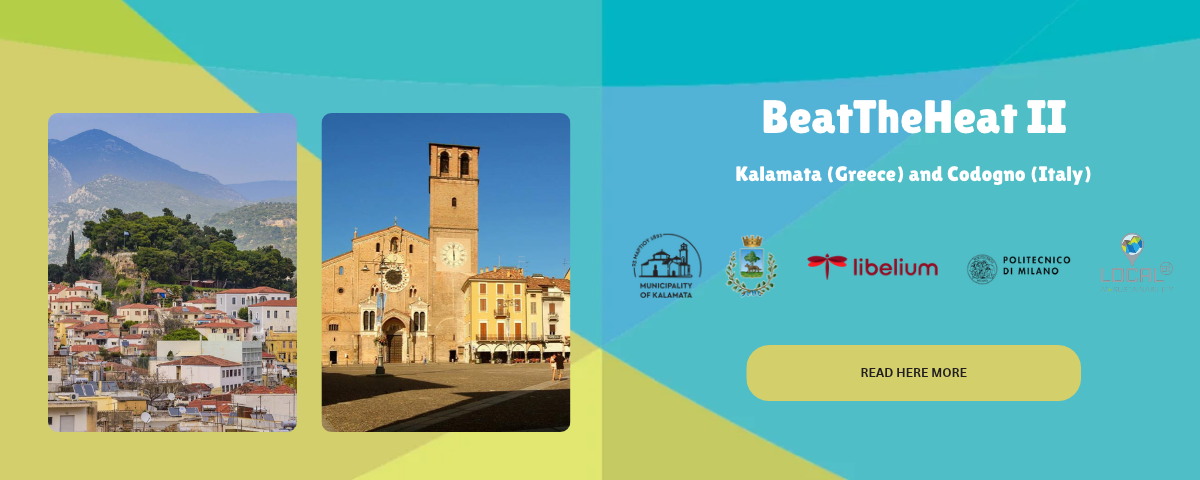
Basic Pilot Info:

Title: BeatTheHeat II
Involved Cities: Kalamata (Greece) and Codogno (Italy)
Consortium members: Municipality of Kalamata, Municipality of Codogno, Libelium, Politecnico di Milano, LocalAI
Duration: 01 August 2026 – 31 October 2026 (3 months)
Domains: 1) Predictive sustainable mobility 2) Zero Pollution Actions & Climate Services
Motivation:
Combating Urban Heat Islands (UHIs). The Mediterranean region is warming 20% faster than the global average. Rising temperatures intensify heat stress, spike energy demand for air conditioning, and threaten public health—particularly for vulnerable populations.
Providing Data-Driven Infrastructure Tools. City managers urgently require actionable, cross-sectoral data to guide long-term urban planning and investments in green infrastructure, sustainable mobility, and nature-based solutions.
Demonstrating Reusability and Cost-Effectiveness. A core driver is proving that sophisticated climate and mobility services (like Cartagena's EcoRoutes) can be seamlessly transferred to a new city (Kalamata) and reused rather than being built from scratch, significantly reducing development effort and costs.
Geographical Expansion of the Shared Data Space. The project seeks to scale the existing BeatTheHeat ecosystem from isolated cities into an operational, multi-national European data space by onboarding Kalamata (Greece) and Codogno (Italy).
Establishing an Onboarding Blueprint. By documenting the technical, legal, and governance hurdles faced during expansion, the project aims to deliver a step-by-step replication guide for any future European city wanting to join a sovereign data space.

Use Case Description:

BeatTheHeat Phase II is the strategic continuation and expansion of the BeatTheHeat data space (Project 2024/02), successfully established and funded during the 2nd DS4SSCC Call. While the initial phase established the foundational architecture and validated the first pilot across two Mediterranean cities—Cartagena (Spain), Naples (Italy), and Taranto (Italy)—this second phase focuses on three core objectives: scalability, standardising the onboarding process, and demonstrating the tangible reusability of cross-border data services across a wider European geography.
By incorporating two new municipalities Codogno (Italy), and Kalamata (Greece) BeatTheHeat Phase II will transition from an isolated pilot into a robust, multi-national (+3 cities), and fully operational data space (+demonstrations). Through this expansion, a combined urban population across Southern and Central Europe will directly benefit from climate-resilient urban services powered by shared, interoperable data.
During this phase, the pilot will achieve the following key milestones:
Real-World Onboarding Demonstration & Blueprinting: This phase will serve as a practical, end-to-end demonstration of integrating new participants into the data space. We will comprehensively document the entire onboarding journey. Value generated: This clear, step-by-step documentation will act as a foundational application of the DS4SSCC governance blueprint, making it easier for future participants to join the ecosystem. Furthermore, it will provide highly valuable insights for other similar data space initiatives, allowing them to learn from, adapt, and validate this critical onboarding process.
Development of Services and Use Cases: To drive innovation, we will design and deploy entirely new, tailored services and use cases specifically meant to address the unique climate and urban needs of the newly incorporated cities.
Scalability Through Service Reuse: To prove the interoperability and scalability of our ecosystem, we will successfully demonstrate how a service that already exists within the data space can be seamlessly transferred and reused by Kalamata. Value generated: This proves the cost-effectiveness of the data space, showing that once a solution is created, it can be efficiently scaled to benefit other regions without starting from scratch.
Local challenges addressed: Urban Heat Islands (UHIs) are an increasingly critical challenge in European cities, particularly in the Mediterranean region, which warms 20% faster than the global average. Rising temperatures intensify heat stress, increase air conditioning energy demand, and pose direct risks to public health—especially for vulnerable populations such as the elderly and those with cardiovascular or respiratory conditions. City managers urgently need data-driven tools to guide investments in green infrastructure, sustainable mobility, and urban planning.
Green Deal domains: The pilot addresses two primary Green Deal domains: (1) Climate adaptation and weather/climate data services – through the expansion of UHI mapping, thermal comfort analysis, and climate risk tools to Codogno, and Kalamata; and (2) Sustainable mobility planning – through the deployment of the EcoRoutes service in Kalamata (reused from Cartagena) and a new smart bicycle routing service in Kalamata. The pilot also addresses the New European Bauhaus initiative through nature-based urban design solutions and biophilia-oriented planning tools deployed in all two cities.
Communities and sectors involved: The pilot engages six organisations across two countries: two municipalities as data providers and users, and three technology partners (Libelium, POLIMI, LocalAI) as data space operators, service developers, and data intermediaries. Cross-sectoral data sharing integrates urban mobility, meteorology, environmental monitoring, urban biodiversity, and public health domains.
Added Value:
The BeatTheHeat II project delivers significant added value across strategic, technical, and operational dimensions:
Tangible Service Reusability. It demonstrates that urban climate and mobility solutions do not need to be built from scratch. Successfully transferring the EcoRoutes service from Cartagena to Kalamata proves ecosystem interoperability and establishes a cost-effective, scalable model for European cities.
Actionable Onboarding Blueprint. The project documents the end-to-end integration journey—including legal, technical, and governance challenges—of onboarding new cities into a shared data space. This creates a practical, step-by-step replication guide aligned with the DS4SSCC blueprint to accelerate future ecosystem growth.
Climate-Aware Citizen Mobility. By deploying easy-to-use routing services like EasyRide in Kalamata, the project dynamically integrates topography and road networks with real-time environmental data to actively lower urban heat exposure for cyclists and pedestrians.
Enhanced Urban Resilience & Public Health Protection. The integration of cross-domain data (combining meteorology, air quality, and traffic data) provides city managers with the precise infrastructure tracking needed to mitigate Urban Heat Island effects and safeguard vulnerable populations from heat stress.
Ecosystem Interoperability & Compliance. Utilising recommended open standards (such as FIWARE, NGSI-LD, and IDSA) ensures that the newly established data pipelines align perfectly with broader European data infrastructure efforts, maximising future scalability without vendor lock-in.