

Training and Mentoring
Pilots Support & Assessment
Once the applications are selected as winning pilots, the Pilot Support team will take over the support role.
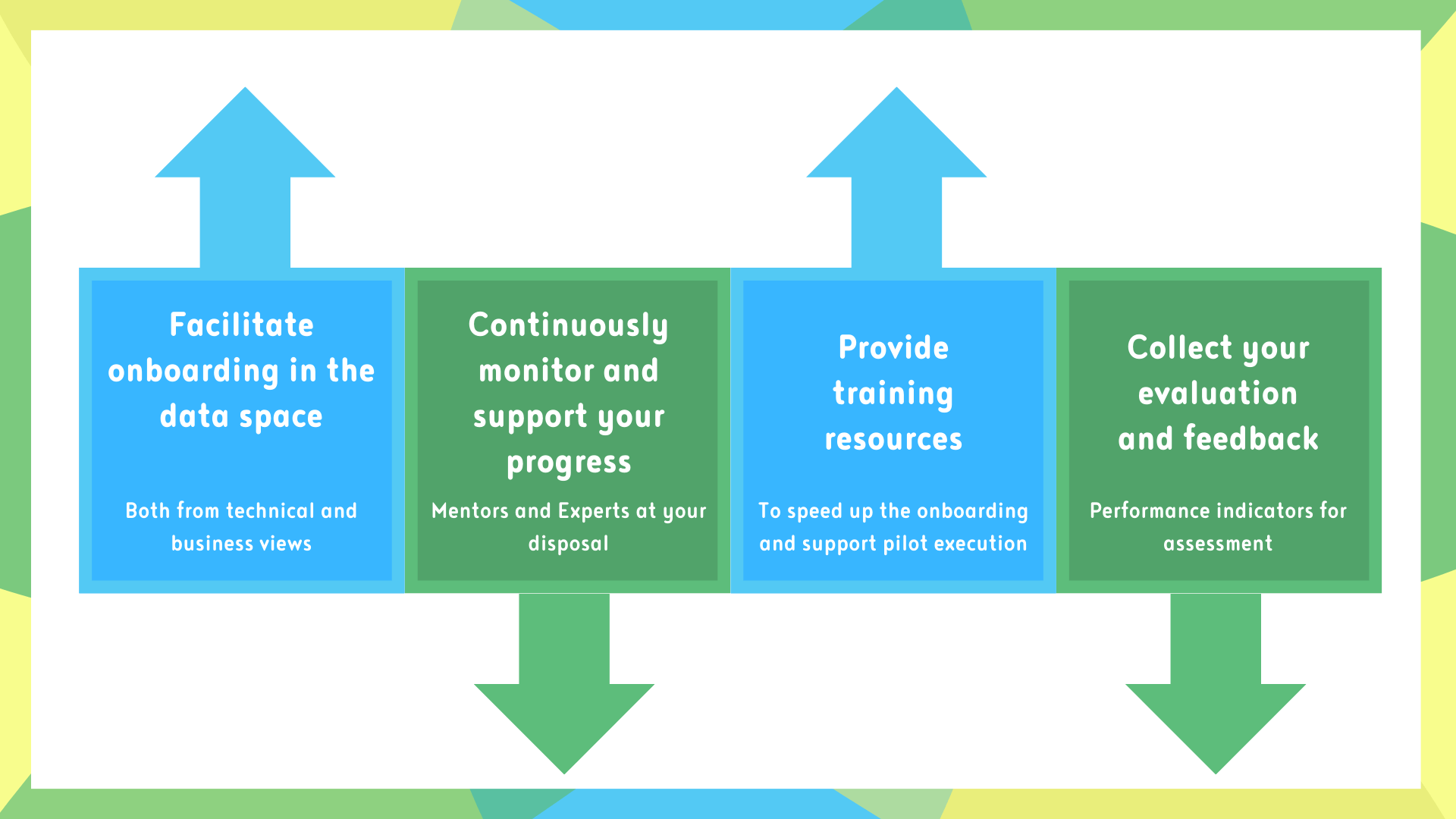
During the pilot implementation period, pilot consortia are provided with various levels of support to ensure proper delivery of solutions, both in terms of budget and timely execution. Participation in the Pilot Support programme is expected and pilot consortia should include their effort in the budget.
The support activities encompass the onboarding process, mentoring, and training program across the pilot implementation period.
Selected pilots will receive structured support throughout the project duration, including a kick-off meeting in the first month to align expectations and define objectives, as well as three mentoring sessions with the DS4SSCC DEP mentoring team distributed across the three-month implementation period, providing continuous guidance and expert feedback; in addition, participants will be granted access to dedicated training resources and support materials to facilitate implementation and strengthen their capacities during the pilot.
Expected Schedule of the Pilot Support

Onboarding
During the onboarding, detailed guidelines will be provided to the participants. It starts with an onboarding workshop for all winners in each CfP round to introduce pilots to the onboarding process, training, monitoring and evaluation plans.
This is followed by individual meetings scheduled with each pilot to discuss specific plans, collect necessary information (benchmarking) and address their needs.

Mentoring
A mentoring team will support the pilots throughout the project duration, serving as a central point of contact, facilitating onboarding and alignment with the data space, and providing guidance at key moments during implementation. The team will help monitor overall progress and connect participants with relevant resources when needed, while additional support on technical, business, governance, or legal aspects may be provided as appropriate. Participants will also have access to structured training materials to support their activities during the pilot.
Find more information from the Call for Pilots Manual.
MONITORING AND ASSESSMENT
The monitoring and assessment of the pilots consist of benchmarking, mid-term and final evaluations, using pre-defined key performance indicators (KPIs).
They are categorised under Governance, Impact, Management, Support, and Technical indicators, each with minimum target values for evaluation criteria.
These target values represent the minimum goals for each pilot by the end of execution.
Find the list of KPIs in the Call for Pilots Manual.

An overview of the progress in KPI measurements should be provided as part of the interim and final reports of the awarded pilots.
The interim report must provide an overview of their progress along with their tasks, including datasets used, contribution to the Data Space, refinement of the blueprint, and local and general lessons.
The final report must provide a comprehensive summary of the activities undertaken, any deviations from the plan and their justifications.
Training Programme

In addition to evaluating progress regarding KPIs, the pilots are required to also participate in an overall impact assessment of the piloting activities, based on the DS4SSCC-DEP project’s Impact Framework.
The pilots will fill in a self-assessment survey at the start of their projects, where they will need to specify concrete indicators for impact measurement.
Furthermore, the proposed framework guides pilot consortia to break down their intended impact into measurable outputs, outcomes and longer-term impact objectives.
Read the full Pilots Onboarding and Support Plan here.
*Note: This is a generic support plan, and the methodology has been scaled down for the fourth round to take into consideration the reduced duration and scope of the call

Get support: support@ds4sscc.eu
Pilot teams will be provided with access to structured training materials (refer to Table 10 for a list of activities), designed to address the needs of both demand-side (local authorities) and supply-side (solution providers) participants. Decision-makers and IT experts from local authorities, as well as business developers and IT experts from solution providers, will be able to engage with content tailored to their respective roles, expertise, and knowledge levels.