

DYNAMO
Basic Pilot Info:

Title: DYNAMO
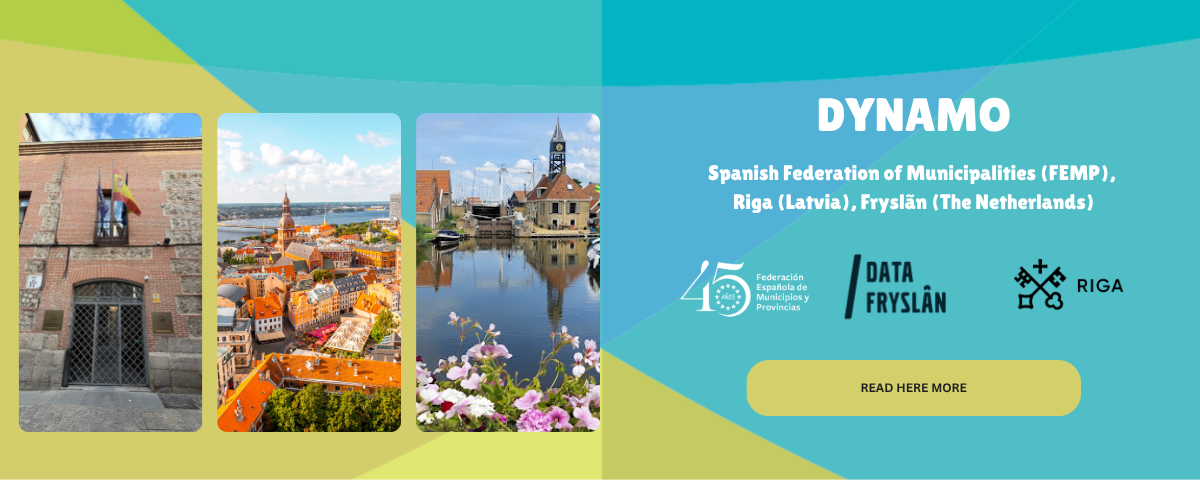
Involved Cities: Spanish Federation of Municipalities (FEMP), Riga (Latvia), Fryslãn (The Netherlands)
Consortium members: Spanish Federation of Municipalities and Provinces (FEMP), Data Fryslan, Riga City Council
Duration: 01 August 2026 – 31 October 2026 (3 months)
Domains: 1) Predictive traffic management/sustainable mobility planning. 2) Zero pollution actions
Motivation:

European cities and regions face increasingly complex mobility challenges, including congestion at peak hours, underutilisation of transport capacity during off-peakperiods, fragmented mobility services and the difficulty of combining data held by different public and private actors.
Although large volumes of mobility, traffic and contextual data are already available, they are often distributed across separate systems, formats and organisations, limiting their effective use for public decision-making.
DYNAMO addresses this challenge by demonstrating how a federated data space can bring together heterogeneous mobility information in a governed, interoperable and secure environment. By combining transport, traffic, fleet availability, events, weather and other contextual data, the pilot aims to provide publicauthorities with a more integrated understanding of mobility patterns and stronger analytical capabilities to support more adaptive, efficient and sustainable mobility planning.
The project also responds to the broader European need to move from isolated local data platforms towards interoperable data ecosystems that allow cities and regions to share and reuse data while maintaining control and sovereignty over their information.
Use Case Description:

This use case proposes the development of an intelligent system capable of adapting, in real time, the supply of public transport and shared mobility to the actual demand of cities. The solution is based on the integration and federation of multiple heterogeneous data sources (occupancy, traffic, fleet availability, events, weather conditions and incidents) through the Smart Urban Infrastructure Data Space (EDINT). EDINT is a data space created under the Spanish Recovery, Transformation and Resilience Plan, funded by the European Union through the NextGenerationEU mechanism, and aligned with the European Data Strategy, the Data Governance Act and the EU Cloud Federation, among others.
In particular, the pilot will allow testing, in a real environment, mechanisms to optimise transport operations (frequencies, routes, fleet redistribution), generate personalised recommendations for users, and improve decision-making through advanced analytics and AI. The use case addresses key issues such as rigid schedules, peak-hour congestion, underuse during off-peak hours and lack of coordination between transport modes. The solution involves multiple stakeholders, including public administrations, transport operators, shared mobility companies and data providers.
Expected benefits include reduced congestion and emissions, improved operational efficiency, enhanced quality of mobility services for citizens and the creation of new data-driven business models. Impact will be measured through indicators such as transport occupancy, waiting times, traffic reduction, fleet redistribution efficiency and citizen satisfaction. The solution is also designed to be replicable and scalable to other European cities, contributing to the development of the European Mobility Data Space and the federation of Local Digital Twins.
Added Value:

DYNAMO’s added value lies in demonstrating how existing data-space capabilities can be transformed into practical decision-support services for urban mobilityacross different European territorial contexts.
Rather than developing a new infrastructure from scratch, the project builds on the existing EDINT data space and validates how heterogeneous mobility datasetscan be integrated, semantically aligned and shared through interoperable mechanisms while preserving data sovereignty and governance.
The pilot combines three complementary dimensions: a federated and interoperable data-space approach; advanced analytical and AI-assisted capabilities thatmake complex mobility information more accessible to public decision-makers; and real-world validation in Riga and the Province of Fryslân.
This cross-border validation is particularly important for demonstrating that the approach is not specific to one city or technological environment. By relying oncommon standards, reusable data models, connectors and governance mechanisms, DYNAMO is designed to generate components, methodologies and lessonsthat can be transferred to other European cities and regions.
Through FEMP’s extensive network of local authorities, the project also offers significant potential for scaling and replication, while contributing to the EuropeanMobility Data Space, the federation of Local Digital Twins and the wider European Data Space for Smart Communities ecosystem.